

Be they of naked
strolls down school halls or of flying free over mountains, dreams hold
tremendous sway over our lives. All of us dream, even if you don’t remember
them. And all our lives have been touched by the dreams of others.
History is littered
with amazing tales of dreams, be they insightful, symbolic, or prophetic. We’ll
get to those. First I’ll talk a little about my own nocturnal motion pictures.
I dream every
night. Sometimes I even lucid dream. These dreams have shaped who I am, and
informed my choices in everyday life. When I was in pre-school, from four-to-five
years old, I dreamt of flying to the stars in some kind of star vehicle shaped
like the Big Dipper. Once in that scintillating cloud of interstellar dust, I
became one with the universe and all its secrets. Grandiose, no? Well, the
dream repeated several times. I still recall how amazing it felt, like a sun
rising in my tiny mind, this sense of being filled by an infinite joy and
knowledge of all things. Upon waking up, I felt certain that some day I’d
actually head to space and get bathed in all that good stuff when I was an
adult (some might say this happened, as I have been accused, rightfully so, of
living in outer space at times). It’s notable that I had these dreams not long after
watching Carl Sagan specials on TV and in slideshows at home with my family.

I’ve always
believed I’d be a writer, a belief reinforced by my dreams. Since grade school,
I’ve had a recurrent dream in which I open an impressive leather volume and
start reading what, in my dream, is the best book I’ve ever read. The sentences
and words fall over me like musical drops from a waterfall. At some point in
the dream I realize that I’ve written this book; or that I will write this book
someday. Boundless bliss ensues, mirroring how I imagine a drug like ecstasy
would feel (never done it, if you’re wondering). The coolest variation of those
dreams happened a couple times when my deceased mother would read the book over
my shoulder with me and I’d say, “Can I really write this?” And she’s like, “Of
course!”
Not all my recurrent dreams are blissful and
zen. I mentioned in an earlier post that I have at least two zombie apocalypse
dreams a year. I also have the occasional dream in which I have to walk through
a field of snakes. Then there’s the one where I’m back in high school because
in dream logic I never actually got a high school diploma and to do so I must
re-take math and chemistry, both of which are utterly incomprehensible to me in
the dream (throughout which I keep yelling, “But I have a Master’s in Science!
This is crazy! Why am I here?).
My least favorite
dream? The one where I lose my teeth. I hate it. It feels so real, so
disconcerting. I can taste the ground up teeth, feel them as I spit them out like calcified sunflower seed husks; I’m disgusted at the twisting, crystalline
shape of them, and freaked out at the tiny new teeth already poking out of my
gums. This is generally considered a symbol of change in life, as Stephen King
used as part of his process of body change in his book, The Tommyknockers.
Stephen King, in fact, has mined his dreams for numerous novels, including Misery. Others have done similar things,
as I’ll get to later.

It was fairly
serendipitous that my first science job was as a research assistant in a sleep
lab at Harvard Medical School. The study didn’t involve dreaming, but sleep
deprivation – we’d keep people up for 88 hours at a time to study the effects
that not sleeping had on their body, like blood pressure, brain activity, and
their immune systems. Nobody went insane, contrary to the popular belief
perpetuated by the 1950s New York radio DJ, Peter Tripp’s self-experiment and
stunt with sleep deprivation, where he stayed on-air for over three days
straight with the assistance of pep pills. He experienced hallucinations,
paranoia, and supposedly had long-term psychological effects, including
believing he was an imposter of himself. No one at our study experienced
psychosis, although good Lord did they get tired and grumpy. That’s partly
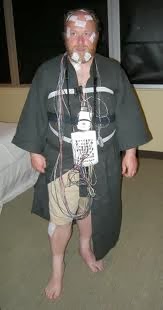
because they had a 10-CM rectal probe inserted to monitor body temperature, and
were wired like a PA system: head electrodes to monitor brain waves, an IV and
catheter for blood draws, an EKG taped to their chest, and 24-hour beat by beat
blood pressure finger cuff. Basically they signed on for exotic torture to the
tune of $1000. But it was fascinating research.
Moving on to
others. Some people’s sleep and dream experiences are astonishing. A roommate
of mine said his father, when he couldn’t figure out a mechanical problem with
a car or a piece of farm equipment, would go to bed with the problem in mind,
and then he’d dream of an answer for it. It was a fairly straightforward,
logical process for him to access his creative neural clusters to problem solve.
Creativity, science is beginning to show, is probably a process by which a
constellation of neural networks communicate with each other; it’s not that old
left brain/right brain thing we’ve been brought up on. Dreaming amps up that
creative communication for some.
Likewise, a
student of mine at the university I teach at in Finland really blew me away
with how he learned to optimize his sleep time. He’d been one of 30 pilots in
the Italian airforce, a freakishly competitive and demanding undertaking, from
getting in, to staying in, to staying alive. Even though he operated on
relatively little sleep, less than five or six hours, that time sleeping still
got in the way of his studies. So he learned to turn his dreams into a flight
simulator. He’d fall asleep, drift into a dream flight simulator, and practice
all the things he’d been studying while dreaming. The next day he’d go into his
real flight simulator or airplane and he’d feel he’d have a leg up on the
exercise. While this blew my freaking mind, I have heard doctors say they
experienced similar things during their 90-hour-work-week and
4-hours-sleep-a-night residencies. (Quick aside—as your mind doesn’t actually
rest during REM sleep, when dreams happen, it further amazes me that people can use what little sleep they have as dream theaters and dream
flight simulators; deep, restful sleep is supposed to be necessary for keeping our body temperature steady, for multiple health systems, for cognitive function, and more. One of the reasons we have such terrible, nightmarish sleep after getting drunk is that drunken sleep is stuck in the REM state).

And then there are
those whose dreams actually altered history. Robert Louis Stevenson was an
extraordinary dreamer, able to conceive whole plots in his dreams and return to
them in successive nights until he had essentially conceived the books for
which he would become famous, such as Dr. Jekyl and Mr. Hyde. Likewise, Mary
Shelley dreamed of Dr. Frankenstein and his monster after being challenged by
Lord Byron to come up with her own ghost story. This happened, not
coincidentally, at the same time experiments in electricity were being
conducted on cadavers, which people thought were being returned to life because
they were flopping and writhing about on tables after being juiced; this was in
1816, a time when the body’s nervous system and its conductivity was poorly
understood.

The understanding
of the nervous system was improved a century after Frankenstein via a dream by Nobel-winner, Dr. Otto Loewi,
who dreamed of an experiment that would prove correct his theory on chemical
transmission of nerve impulses. He was far away from the only scientist to have
dreams that would transform his field.
You wouldn’t think of chemistry as a scientific
field of dreams, but it essentially is. Chemistry’s most essential tool, the
periodic table of the elements, was conceived by Russian chemist, Dmitri
Mendeleev in a dream. Like many before him, Mendeleev had been trying to develop a
unifying organization to the 63 elements that were known at the time, in 1863.
He arranged them all on notecards, got frustrated, and passed out on them. It
was like the old tale about sleeping with your math book under your pillow,
except Mendeleev dreamed up of one of the most important tools in human
history.

Friedrich August Kekulé von Stradonitz furthered the chemistry dreams tradition.
After years of struggle, he finally grasped the structure of organic molecules through
a dream in which atoms began to whirl and dance together. The smaller atoms
paired up, and the larger atoms embraced them. Veterans of organic chemistry
class (I shudder still at the words) understand this as carbon’s tetravalent
nature, how it has four bonding sites. It is the foundation of organic
chemistry. Von Stradonitz later had a dream in which the dancing atoms formed a
snake that ate its own tale, which he understood was the structure of the
benzene molecule, a particularly elusive structure for the brilliant dreamer.

It wasn’t a dance, exactly, but James
Watson said in a 2005 TED talk that he helped co-discover DNA and its
double-alpha-helix structure partially through a visionary dream involving
spiral staircases. And Einstein, for his part, had numerous dreams that elucidated and illustrated various theories, including relativity.

In mathematics, Srinivasa Ramanujan, the
Indian genius mentioned in the bar scene in Good
Will Hunting, conceived of many of his hundreds of theorems and equations
in dreams in which they were presented to him by the Hindu goddess Namakkal.
And then there are prophetic dreams. Abraham
Lincoln dreamed of his own death 10 days before his assasination. Lincoln was,
in fact, highly devoted to the power of his own dreams, even telling his
generals that he knew when to expect important news on the status of the Civil
War based on dreams he’d had.

It’s a tragic irony of history that where
Lincoln didn’t use his dream to stave off death, Adolf Hitler did. Hitler
dreamed, in World War One, that he and his brothers in arms would be swallowed
by the Earth and engulfed in molten metal. He woke up, left his trench, and
watched as a mortar exploded in the space he’d just vacated, killing everyone
else but him. Personally, I wouldn’t put it past him to have fired the mortar
himself just to be a scheisskopf.
I’ve always been fascinated by Carl Gustav
Jung, so we’ll conclude with him. He is one of the founding fathers of
psychology, Freud's scholarly heir to the throne, but Jung was also an unabashed mystic. He wrote a
major tome on man and his symbols, many of which are derived from alchemy, that
I’ve vaguely woven into my novel. He also had numerous prophetic dreams. In
one, his dead father visited him to ask about marital psychology; two months
later Jung had a nightmare in which a wolfhound in a frightful forest was
commanded by “the Wild Huntsman” to carry off a soul. Jung awoke “in deadly
terror;” his mother died that same day; Jung later saw that his father’s
dream visitation had been a warning.

In October 1913, Jung began having ominous
visions, dreams, and sensations portending war across Europe. As
he recounted in his memoir:
“I saw a monstrous flood covering all the
northern and low-lying lands between the North Sea and the Alps. When it came
up to Switzerland I saw that the mountains grew higher and higher to protect
our country. I realized that a frightful catastrophe was in progress. I saw the
mighty yellow waves, the floating rubble of civilization, and the drowned
bodies of uncounted thousands. Then the whole sea turned to blood. This vision
lasted about an hour.... Two weeks passed; then the vision recurred, under the
same conditions, even more vividly than before, and the blood was more
emphasized. An inner voice spoke. “Look at it well; it is wholly real and it
will be so. You cannot doubt it.”
While this was technically a vision as it happened before he'd gone to bed, it was followed up by three related dreams in
the spring of 1914, in which Europe was covered by vegetation-killing ice and
frost. War broke out three months later.

So this is a fairly epic post. Those of
you who managed to read to the end probably did so because you have a personal
connection to dreams and dreaming. Please do share any remarkable dream experiences you
have had. I'd love to hear them!


